Water: Ionization Energies and Dyson Orbitals (MRSF-EKT)
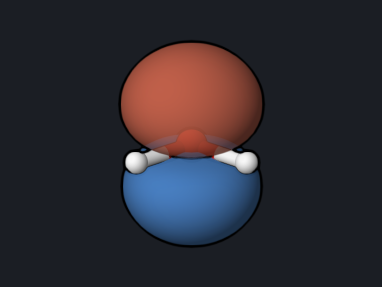
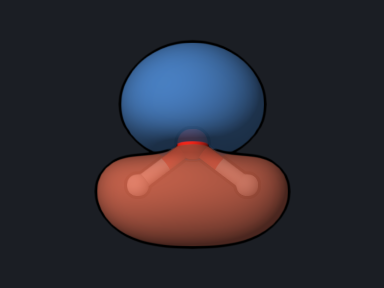
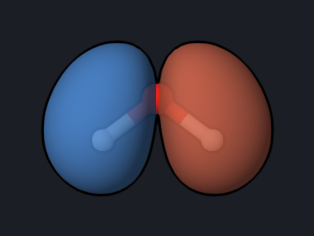
The extended Koopmans' theorem (EKT) gives ionization energies from a correlated wavefunction, together with the Dyson orbital of each ionization: the orbital from which the electron is removed. Dyson orbitals are what photoelectron spectroscopy measures. OpenQP computes them from the MRSF-TDDFT ground state.
Copy and run
mrsf(nstate=10)/bhhlyp/6-31g* ekt scf(save_molden=true)
geom="""
O      0.000000     0.000000     0.122745
H      0.000000     0.759541    -0.471922
H      0.000000    -0.759541    -0.471922
"""
openqp water-ekt.oqp
ekt computes ionization potentials (the default; ekt(ip=false,ea=true)
gives electron affinities instead) from the relaxed MRSF S0 density.
scf(save_molden=true) writes the Dyson orbitals to
water-ekt_dyson_rohf_bhhlyp_6-31gs.molden. The run takes about 2 seconds.
What you get
  MRSF-EKT ionization potentials (Dyson roots)
  Rows index EKT Dyson roots/orbitals, not TDDFT excited states.
  dyson      eig(ha)        eBE(ha)        eBE(eV)       metric       strength
      1      -19.692297       19.692297      535.8547      1.000000      1.000000
      2       -1.136394        1.136394       30.9228      1.000000      1.000409
      3       -0.593666        0.593666       16.1545      1.000000      1.005962
      4       -0.454481        0.454481       12.3671      1.000000      1.003072
      5       -0.378120        0.378120       10.2892      1.000000      1.002174
eBE is the electron binding energy, that is, the ionization energy, and
strength the pole strength of each Dyson orbital.
| Ionization | MRSF-EKT (eV) | Experiment, vertical (eV) |
|---|---|---|
| 1b1 (out-of-plane lone pair) | 10.29 | 12.62 |
| 3a1 | 12.37 | 14.74 |
| 1b2 | 16.15 | 18.51 |
| 2a1 | 30.92 | — |
| 1a1 (O 1s) | 535.85 | — |
Reading the result
- The order of the ionizations and the shape of each Dyson orbital match the photoelectron spectrum: the first electron is removed from the out-of-plane oxygen lone pair.
- With this small basis set and BHHLYP, the three outer-valence ionization energies are 2.3–2.4 eV below the experimental vertical values, so the spacing between the bands is reproduced much better than the absolute values. Larger, diffuse basis sets change the absolute values.
- The Dyson orbitals are in the Molden file with the labels
Dyson-IP-state-1toDyson-IP-state-5; open the file in OQP Studio Analysis or OpenqpView and select them by label.
Electron affinities: ozone
ekt(ip=false,ea=true) gives electron affinities instead. Ozone binds an extra
electron (experimental electron affinity 2.10 eV), and a basis set with diffuse
functions is needed for the anion:
mrsf(nstate=10)/bhhlyp/6-31+g* ekt(ip=false,ea=true)
geom="""
O      0.000000     0.000000     0.444340
O      0.000000     1.083397    -0.222170
O      0.000000    -1.083397    -0.222170
"""
Download ozone-ekt-ea.oqp (experimental geometry, r(O–O) = 1.272 Å, ∠OOO = 116.8°; about 6 seconds)
  MRSF-EKT electron affinities (Dyson roots)
  Rows index EKT Dyson roots/orbitals, not TDDFT excited states.
  dyson      eig(ha)        eBE(ha)        eBE(eV)       metric       strength
      1       -0.163309        0.163309        4.4439      1.000000      1.006303
      2        0.095599       -0.095599       -2.6014      1.000000      0.999194
Only the first root is bound (positive electron binding energy): MRSF-EKT gives an electron affinity of 4.44 eV, 2.3 eV above experiment. Together with the ionization energies of water, which are about 2.3 eV too low, this shows that the EKT ionization and attachment energies at this level are shifted by a similar amount in opposite directions; compare trends between molecules rather than absolute values.
Try next
- Compare
6-31g*withaug-cc-pvdzfor the first ionization energy.