Alanine Dipeptide: QM/MM Across a Covalent Bond
In the formaldehyde QM/MM examples the QM region is a whole molecule. In proteins the QM region usually cuts through covalent bonds. OpenQP then caps each cut bond with a hydrogen link atom. This example puts the C-terminal amide group of the alanine dipeptide in the QM region, optimizes it inside the fixed MM environment, and runs ground-state QM/MM dynamics.
Files
Download into one folder:
ala-qmmm-opt.oqp,
ala-qmmm-md.oqp, and
ala.pdb (the alanine dipeptide, 19 atoms, from the
repository QM/MM examples). The amber14 force field ships with OpenMM, which
must be installed (pip install openmm).
Step 1: QM/MM optimization
rhf/6-31g opt(S0) qmmm(forcefield_files="amber14-all.xml",qm_atoms="8,9,16,17,18",cutoff=NoCutoff)
geom="ala.pdb"
openqp ala-qmmm-opt.oqp
qm_atoms="8,9,16,17,18"(0-based PDB order) selects the carbonyl C and O and the N, H1, and H2 of the terminal NH₂. Everything else is MM, described by amber14 withcutoff=NoCutoff(an isolated, non-periodic system).- The selection cuts the bond between the carbonyl C and Cα. OpenQP adds one hydrogen link atom on that bond, so the QM calculation is effectively on formamide, H–C(=O)–NH₂, polarized by the MM charges.
- In a QM/MM optimization only the QM atoms move; the 14 MM atoms stay fixed.
The run takes about 1 minute:
   PyOQP: QM/MM geometry optimisation: 5 QM atoms, 5 movable atoms (radius 0.0 A, 0 constrained distances), 14 fixed; state 0; native RFO/BFGS, cartesian coordinates, trust 0.20 (max 0.50) bohr, maxit 30
   PyOQP: QM/MM optimisation converged after 59 evaluations: E = -168.9275191488 Hartree, rms grad 9.24e-05, max grad 1.81e-04 Hartree/bohr; full-system geometry written to ala-qmmm-opt_opt.pdb
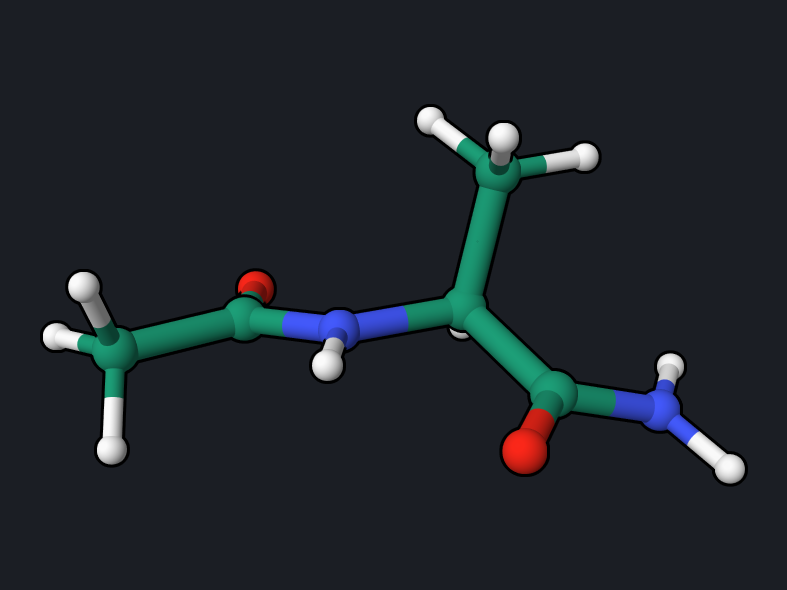
The optimized full system is written as a PDB file,
ala-qmmm-opt_opt.pdb, which is the structure in the picture above.
Step 2: QM/MM molecular dynamics
rks/bhhlyp/6-31g md(nstep=200,dt=0.5,temperature=300,seed=2) qmmm(forcefield_files="amber14-all.xml",qm_atoms="8,9,16,17,18",cutoff=NoCutoff)
geom="ala.pdb"
openqp ala-qmmm-md.oqp
Now all 19 atoms move: the QM region on the BHHLYP surface and the rest on the amber14 surface, coupled through the embedding. 200 steps of 0.5 fs take about 6 minutes with 4 threads. This QM/MM dynamics driver writes fixed file names:
| File | Contents |
|---|---|
oqp_project.log |
the log |
qmmm_trajectory.pdb |
all 201 frames of the full system, for VMD or OQP Studio |
total_energy.npz |
step, time (ps), potential, kinetic, and total energy (kJ/mol), temperature |
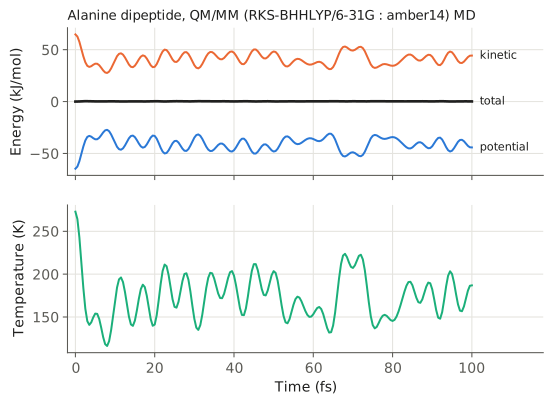
| Quantity | Reference trajectory |
|---|---|
| Initial temperature | 273 K (one 300 K draw for 19 atoms) |
| Mean temperature | 173 K |
| Total-energy range over 100 fs | 0.37 kJ/mol |
Reading the result
- Energy is conserved across the boundary. The total energy varies by 0.37 kJ/mol over 100 fs while about 50 kJ/mol moves back and forth between kinetic and potential energy, so the forces of the QM region, the link atom, and the MM part are consistent.
- The QM energy depends on the boundary. −168.93 hartree is the energy of the capped QM fragment in the field of the MM atoms, not of the whole molecule; compare such energies only between calculations with the same QM region.
- Place the cut on a nonpolar single bond, away from the chemistry of interest; here it is the C–Cα single bond next to the amide group, so a larger QM region is the natural check.
Try next
- Enlarge the QM region to the whole C-terminal residue and compare the optimized amide geometry.
- See the repository
examples/QMMMfor other boundary treatments (frontier_scheme), constraints, and excited-state dynamics.
See also: qmmm,
covalent QM/MM boundaries.