Formaldehyde: Spin-Orbit Coupling
Spin-orbit coupling (SOC) mixes singlet and triplet states and controls the rate of intersystem crossing and phosphorescence. This example computes the singlet and triplet states of formaldehyde with MRSF-TDDFT and the SOC matrix elements between them, including the one-electron spin-orbit term and a mean-field treatment of the two-electron term. The result shows El-Sayed's rule directly.
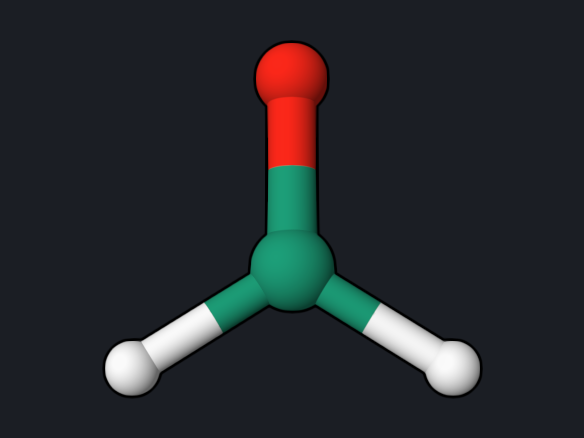
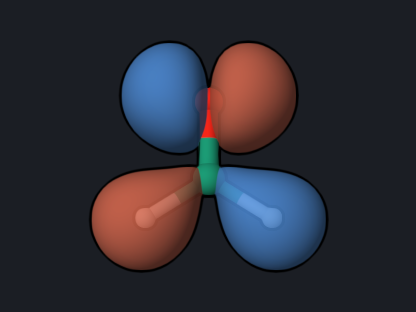
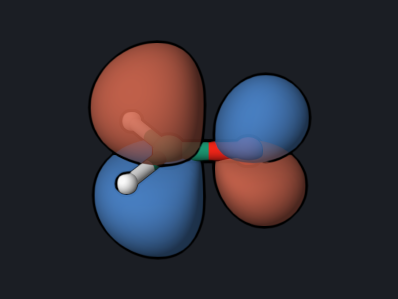
Copy and run
mrsf(nstate=3)/bhhlyp/6-31g* soc
geom="""
C      0.000000     0.000000    -0.526342
O      0.000000     0.000000     0.676110
H      0.000000     0.937620    -1.119884
H      0.000000    -0.937620    -1.119884
"""
openqp formaldehyde-soc.oqp
mrsf(nstate=3) with soc computes three singlets (S0, S1, S2) and three
triplets (T0, T1, T2), then the SOC between every singlet–triplet and
triplet–triplet pair. The run takes about 4 seconds.
What you get
The SOC_MRSF section first lists every matrix element in cm⁻¹, split into
one-electron (1e) and two-electron (2e) parts. The column Absolute is
|1e + 2e| for that spin component. The largest elements are:
  State_i    State_j         Re(1e)      Im(1e)      Re(2e)      Im(2e)      Absolute
     S0    / T0(Ms= 0)       0.0000    -90.0740      0.0000     35.2698   54.804170567800
     S1    / T0(Ms= 0)       0.0000      0.0000      0.0000     -0.0000    0.000000000003
     S1    / T1(Ms= 0)       0.0000    -82.0876      0.0000     31.4124   50.675189621085
It then diagonalizes the full singlet–triplet Hamiltonian and lists the spin-orbit states with their composition:
  State    cm-1        eV        Composition

     1       -0.15   -0.000019        S0 (100.0%)
     2    30971.21    3.839941    T0(+1) ( 50.0%)     T0(-1) ( 50.0%)
     3    30971.21    3.839942    T0(-1) ( 50.0%)     T0(+1) ( 50.0%)
     4    30971.45    3.839971    T0( 0) (100.0%)
     5    32960.08    4.086530        S1 (100.0%)
     6    47753.41    5.920669    T1(-1) ( 50.0%)     T1(+1) ( 50.0%)
     7    47753.43    5.920672    T1(+1) ( 50.0%)     T1(-1) ( 50.0%)
     8    47753.45    5.920674    T1( 0) (100.0%)
| State | Character | Energy above S0 |
|---|---|---|
| T0 | ³nπ* | 3.840 eV |
| S1 | ¹nπ* | 4.087 eV |
| T1 | ³ππ* | 5.921 eV |
| Coupling | Reference value |
|---|---|
| ⟨S0 | H_SO | T0, Ms = 0⟩ | 54.80 cm⁻¹ |
| ⟨S1 | H_SO | T0⟩ | 0 (all components) |
| ⟨S1 | H_SO | T1, Ms = 0⟩ | 50.68 cm⁻¹ |
Reading the result
- El-Sayed's rule. S1 and T0 are both nπ* states with the same orbital occupation, and their coupling is zero. S1 couples strongly to T1 (ππ*), where the orbital type changes. Intersystem crossing from S1 therefore needs the ππ* triplet or vibrational distortion of the molecule.
- S0–T0 coupling (54.8 cm⁻¹) controls phosphorescence from the ³nπ* state back to the ground state.
- The two-electron term matters. It has the opposite sign to the one-electron term and reduces the coupling by about 40%; a one-electron-only calculation would overestimate SOC.
- The spin-orbit splitting of each triplet is below 1 cm⁻¹ in this light molecule, so the spin-orbit states keep almost pure singlet or triplet character.
Try next
- Request different numbers of singlets and triplets with
soc(ns=3,nt=5)and a route withoutnstate:mrsf/bhhlyp/6-31g* soc(ns=3,nt=5). - Pyramidalize the molecule by moving both hydrogens a little along x, and compare the S1–T0 coupling with the planar value of zero.
See also: Spin-Orbit Coupling, MRSF-TDDFT.