Formaldehyde: UV Absorption with TDDFT
Linear-response TDDFT gives vertical excitation energies and oscillator strengths, which together form a computed absorption spectrum. Formaldehyde has a weak, symmetry-forbidden n→π* band in the near UV; this example shows how to find it and identify the orbitals involved.
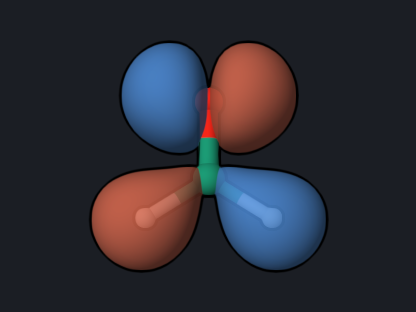
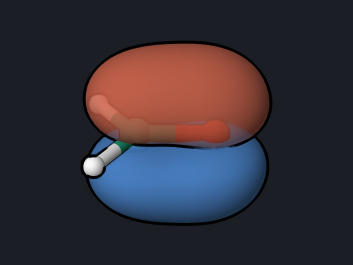
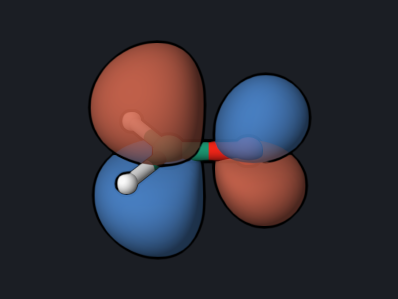
Copy and run
tddft(nstate=6)/pbe0/6-31g*
geom="""
C      0.000000     0.000000    -0.526342
O      0.000000     0.000000     0.676110
H      0.000000     0.937620    -1.119884
H      0.000000    -0.937620    -1.119884
"""
openqp formaldehyde-uv.oqp
tddft(nstate=6) requests the six lowest singlet excited states from the
closed-shell PBE0 ground state; the full linear-response (RPA) equations are
solved by default. The geometry is the PBE0/6-31G* minimum from the
optimization example. The run takes about 4 seconds.
What you get
The log ends the excited-state part with a summary table. DX, DY, and DZ
are the transition-dipole components in atomic units:
  Transition          dE(eV)          DX          DY          DZ      Osc.str.
   0 -> 1            4.104380      0.0000      0.0000      0.0000      0.0000
   0 -> 2            9.299532     -0.0740      0.0000      0.0000      0.0012
   0 -> 3            9.382229     -0.0000     -0.8790      0.0000      0.1776
   0 -> 4            9.965700      0.0000     -0.0000      0.4516      0.0498
   0 -> 5           10.450864     -0.0000      0.0000      0.0000      0.0000
   0 -> 6           11.735688      0.0000     -0.1401     -0.0000      0.0056
The ENERGIES AND STATES block lists the total energy of each state; the
ground state is −114.3680181 hartree and state 1 is −114.2171849 hartree.
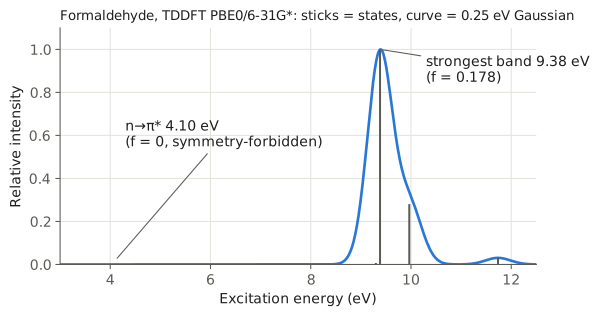
The spectrum above is drawn from the table: each state is a stick of height proportional to its oscillator strength, and the curve is a 0.25 eV Gaussian broadening of the sticks.
Reading the result
- State 1 at 4.10 eV is the n→π* state. Its transition dipole is zero in every direction, so it is dark (f = 0). The excitation moves an electron from the oxygen lone pair n (b2) to the C=O π* orbital (b1). The product b2 × b1 = a2, and an A2 state has no allowed electric-dipole transition from the A1 ground state in C2v. In experiment the band is weak but visible near 4 eV, because vibrations break the symmetry.
- States 2–6 lie above 9 eV. Real formaldehyde has Rydberg states from about
7 eV. The 6-31G* basis set has no diffuse functions, so it cannot describe
these states, and the computed upper states should not be compared with
experiment. Use
aug-cc-pvdzor larger for that region. - The direction of each transition dipole gives the state symmetry: x (out of plane) means B1, y (in plane, perpendicular to C=O) means B2, and z (along C=O) means A1.
Cross-check
PySCF 2.13 TDDFT (PBE0/6-31G* with Cartesian d functions) at the same geometry gives 4.1048, 9.2996, 9.3833, 9.9660, 10.4506, and 11.7391 eV with the same oscillator strengths to three decimals. The agreement is within 4 meV.
Try next
- Add
energy(T0)to compute the triplet states instead of the singlets:tddft(nstate=6)/pbe0/6-31g* energy(T0). - Change the basis set to
aug-cc-pvdzand look for the Rydberg states. - Replace
tddftwithmrsfandpbe0withbhhlypto compare with MRSF-TDDFT, which also describes the ground state together with the excited states.
See also: TDDFT and TDHF,
tdhf.