Research / Theory into discovery
Developing next-generation quantum methods for materials and life sciences.
We develop new quantum theories to address emerging challenges in materials and biomolecular research—and bring these advances into practical simulations through OpenQP.
01 / New quantum theories
Developing the methods that tomorrow’s questions demand.
How can we describe changing electronic character without losing the balance between states?
Materials discovery and biomolecular photochemistry require more than a vertical excitation energy. Bond rearrangement, charge transfer and changes in spin demand methods that can follow different electronic states on a consistent footing.
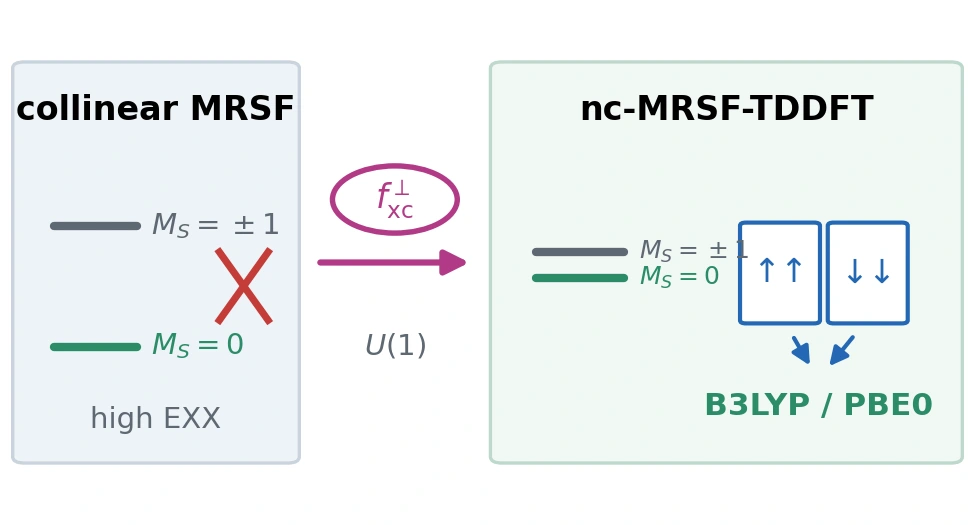
Our research extends mixed-reference spin-flip theory: noncollinear response and core–virtual completion address limitations of the original formulation; unrestricted references and analytic gradients broaden molecular applications; quintet references with a dressed kernel target four-orbital strong correlation.
02 / Developing OpenQP
From a new theory to a useful scientific tool.
How do we make methodological advances available for practical molecular simulations?
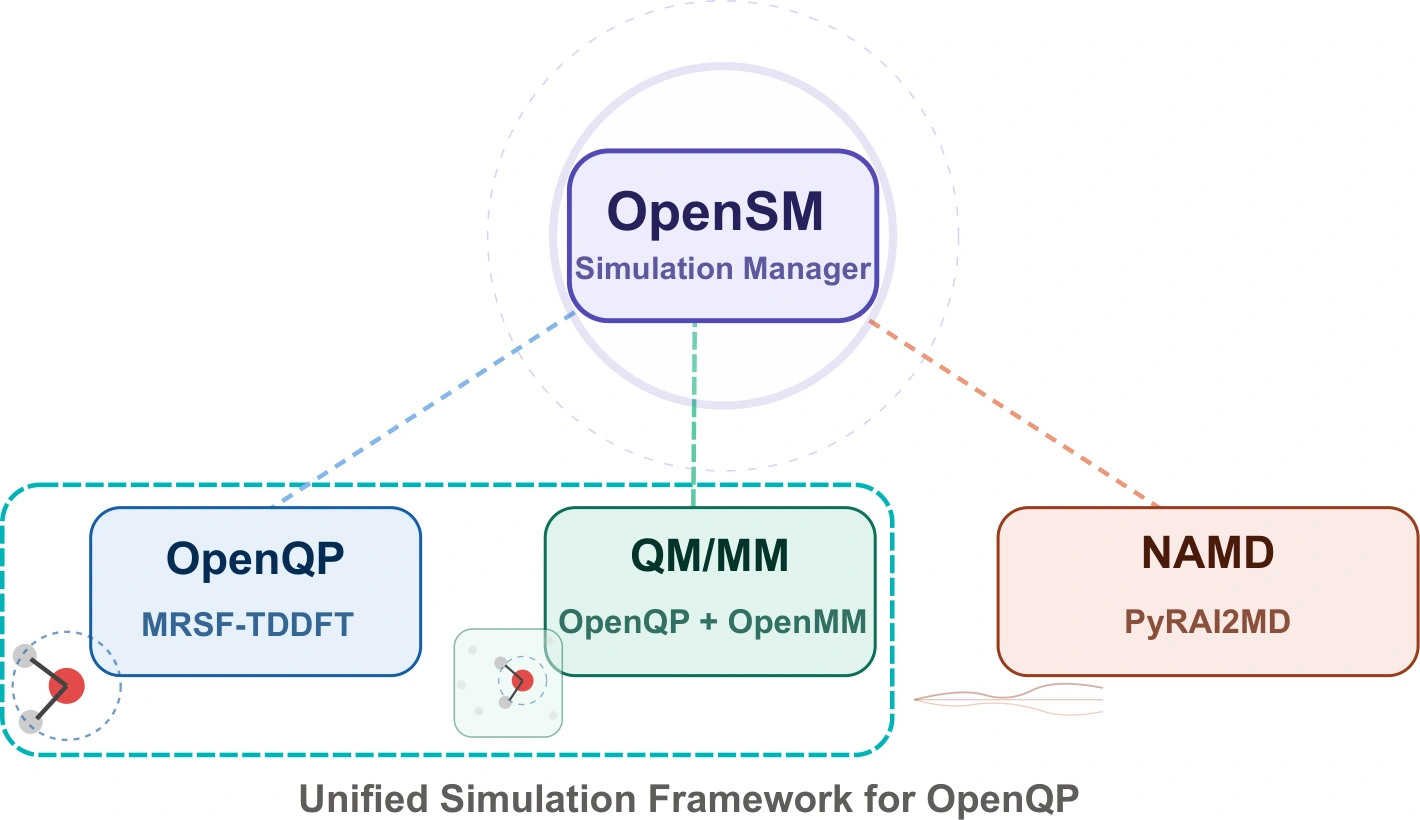
We develop OpenQP alongside the theories it implements. Electronic energies, analytic derivatives and response properties become tools for investigating molecular structure, spectra and dynamics—not isolated calculations.
The OpenQP platform paper describes the electronic-structure library and its Python interface. Our integration research connects OpenQP with molecular mechanics and nonadiabatic dynamics, so that electronic-state methods can be applied to molecules in their environments.
03 / Materials and energy
Understanding the electronic states behind new materials.
Which electronic interactions control the states we want to design?
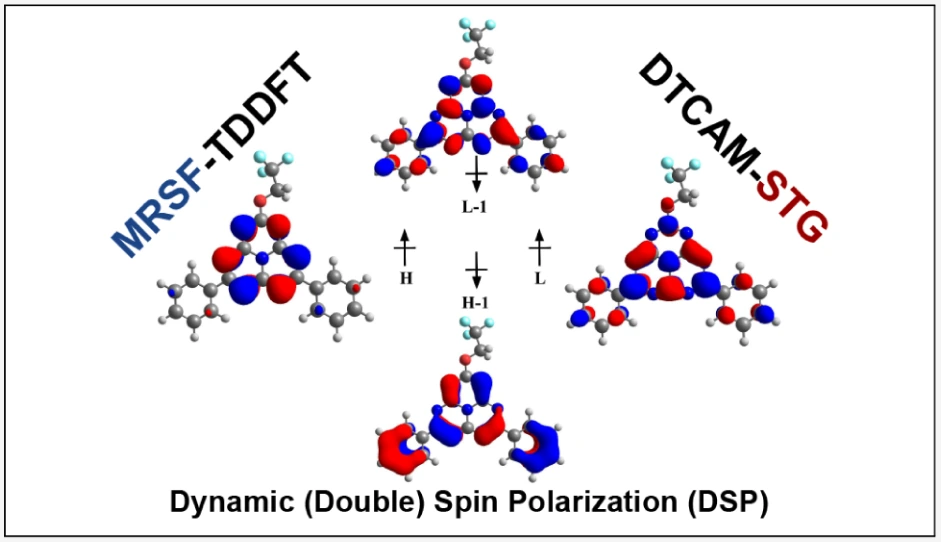
We investigate molecular materials where the ordering and character of excited states determine function. Inverted singlet–triplet gaps, charge-transfer states and coupled triplet pairs connect fundamental electronic-structure questions to opportunities in light harvesting and molecular optoelectronics.
Our study of inverted singlet–triplet materials examines the challenge of screening candidates with MRSF-TDDFT. Related developments address charge-transfer states and the strongly correlated electronic configurations relevant to triplet pairs and singlet fission.
04 / Biomolecular photochemistry
Following light-driven chemistry in molecular environments.
Why does a chromophore relax safely in one environment and react in another?
Nucleobases, fluorescent-protein chromophores and pigment building blocks provide demanding tests of excited-state methods. We study how molecular motion, oxidation state and the surrounding medium change the competition between relaxation pathways.
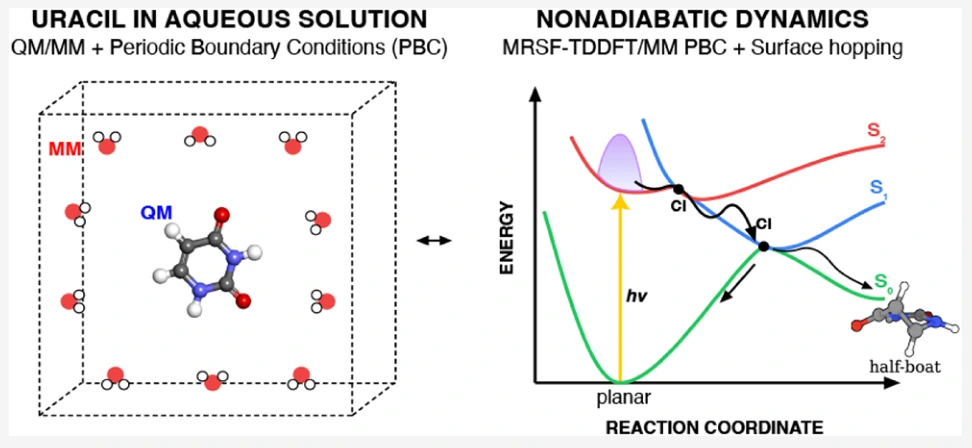
Periodic QM/MM simulations of aqueous uracil connect an explicit molecular environment to nonadiabatic dynamics. Complementary studies examine temperature-dependent GFP-chromophore motion and the balance between photoprotection and photoreactivity in eumelanin building blocks.
05 / Molecular spectroscopy
Connecting electronic-state dynamics with experimental observables.
Which molecular changes produce the signals measured after photoexcitation?
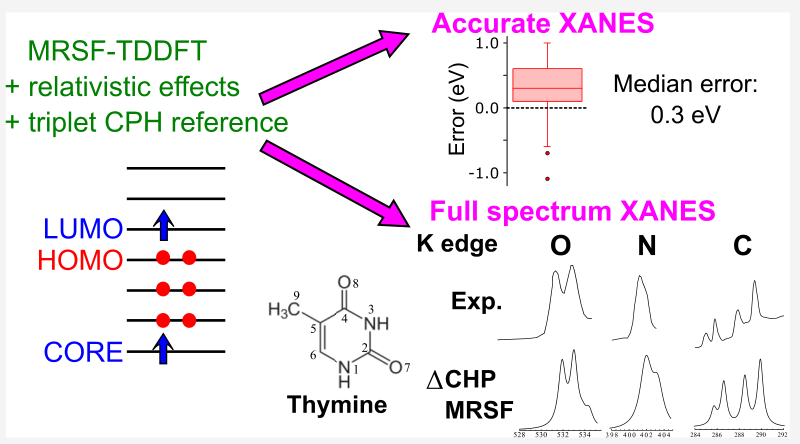
Spectroscopy tests both the electronic-state description and the proposed reaction mechanism. Our methodological work on core excitation, electron removal and spin–orbit coupling helps connect calculated states to X-ray absorption, photoelectron measurements and intersystem crossing.
X-ray absorption provides atom-sensitive information about electronic structure. Extended Koopmans’ theorem addresses ionization, while spin–orbit coupling connects states of different spin. Each property is assessed through its own comparisons and scientific applications.